

The System That Allows you to Capture Your Framework --On the Go
On frameworks, survival, and the operating systems that have been running beneath your surface for years


Second semester sophomore year of college, I walked into the registrar’s office. A deep sense of dread welling in my chest.
Since I was a kid, I’ve always known energetically what is going to happen before it does.
The woman behind the desk informed me that my semester bill was overdue. No one had paid the following semester’s tuition either.
My father had bought a Mercedes-Benz the year before I went to college.
As an immigrant from Burma, he didn’t have the emotional intelligence to sit me down and explain what was happening. Instead, what I got was this:
“You’re a girl. Money conversations aren’t for you. I’m the man. I take care of it.”
But he hadn’t taken care of it.
And my nervous system was spiraling. Another sensation I knew all too well since I was a kid.
I was not going home. I had made that vow years before. Whatever happened next, that was not an option.
So I went to the college library.
I found a book of scholarships. Every single one got a letter from me. The message was essentially the same:
I have no money. I want to become a TV anchor. Will you help me? (My TEDxTalk covers this)
One day, a letter arrived. A doctor in the Midwest —an alumni—-would fund half of my education going forward.
I walked into the CFO’s office — which, at that point, I had walked into more times that month than he would have liked. He was not happy to see me.
He read the letter. And smiled for the first time.
He explained we could knit federal and state grants together to cover most of the rest. But a $2,000 gap remained.
I looked at him and said: Write me a loan agreement. Put whatever APR on it. I will sign it and pay it upon graduation. My parents are no longer in the picture. I need your help to get through this.
He agreed.
I was nineteen years old.

I didn’t know to call it a framework then.
But that’s exactly what it was.
I assessed the situation clearly.
Identified the outcome I needed.
Found every available resource.
Made a specific, direct ask — to many people at the same time.
Knit the pieces together.
And when a gap remained, I sat across from power and proposed the terms myself.
The impossible was never impossible. There had to be a workaround.
That operating system has been running in me ever since. Long before I had language for it. Long before I could teach it to anyone else.

Years later, I was on the NYSE trading floor, delivering a report on TV as the opening bell rang. Getting knocked around as Twitter was going public at the post next to me.
All TV anchors wear an earpiece. It’s how the master control opetors and producers speak to me in remote locations. CNN headquarters were all the way uptown by Penn Station.
“Joya,” the producer shouted into my earpiece. “You have to interview the CEO who rang the opening bell. We just got him. Make your way over to camera position B. I will share the questions to ask in your ear as you walk. You have 30 seconds.
“25 seconds. 15 seconds. Joya, 3, 2, 1” Me getting into camera position to interview the CEO of Party City on the best selling costume in an election year.
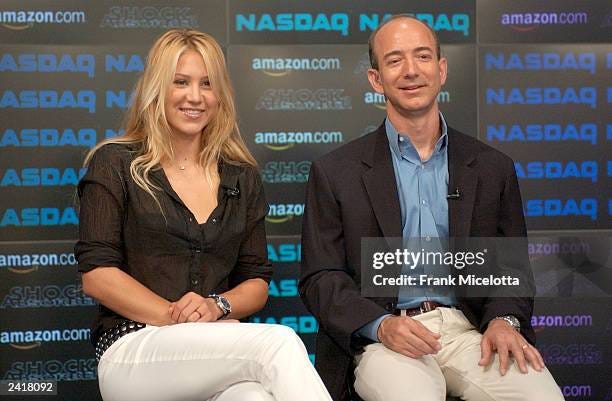
Interviewing Jeff Bezos. August 2023 with tennis player Anna Kournikova ringing the opening bell. She was the bigger star back then.
Greek shipping CEOs who only gave one word answers. A Japanese CEO with his NJ counterpart, translating on side-saddle.
I was already, without fully realizing it, doing the same thing I’d done in that college library so many years ago.
Seeking excellence. Curating proximity to people who operated at a different altitude. Changing who I was around — and therefore who I was becoming — without having named it as a practice yet.
Evelyn Rothstein says it best with this apple analogy.
Today I seek out the company of people in the C-suite. I want to be in rooms where the people and the thinking are exceptional.
This is how I found myself listening to a board director share the most clarifying advice I’ve heard in years:
Always think about how you are packaging yourself up.
She was a scientist. Decades in pharmaceutical research. A record most people in that room would never touch.
She had almost been passed over for a board seat.
Not because she lacked the experience. Because she hadn’t made it legible.
The feedback she got as she was interviewing for board directorship: She hadn’t demonstrated how, as a scientist, she was capable of managing multiple stakeholders, which is what board directors do.
What they didn’t see — what she hadn’t shown them — was that she had brought a drug to market.
Do you know what it takes to bring a drug to market? Regulators. Scientists. Legal teams. Government bodies. International partners. Clinical trial participants. Years of complex, multi-directional stakeholder coordination.
She had done it. She just hadn’t named it.
She survived — and got the seat — because she had been very smartly maintained a living document. A running record of her skill set. Anytime she upskilled or a learned something new, she added it to this ‘living document.’ It all lived in one place.
She went back and read it. And she saw it immediately:
Wait a minute. That is stakeholder management. I have this.
This is the pattern I see in virtually every accomplished woman I work with.
The capability is there.
The results are there.
The framework that produced those results is still living in her head — unnamed, unstructured, invisible to everyone, including sometimes herself.
What lives only in your head cannot be referenced in a high-stakes room.
Cannot be transferred to someone who needs what you know.
Cannot become the basis of a premium offer.
Cannot get you the board seat. The keynote.
This week I spoke to a woman who has the framework, named it even. But ——she didn’t have the language to make the overarching story she was telling —-visible.
Everything she shared was too ‘inside baseball,” so people couldn’t see themselves in the story she was telling or the service she was selling.
She paid good money for a speaking agent. Her speaking was limited to breakout rooms.
Never the main stage.
I’m going to write a post about how to socialize your framework and make it visible next.
But for now—-
What a Living Framework Document Actually Is
It is not a resume.
It is not a LinkedIn profile.
It is not a list of titles and dates.
It is the translation layer between what you’ve done and what you’re capable of next.
Weak: “I have extensive experience managing complex environments.”
Strong: “I brought a drug to market. Here is the system I used to manage multiple stakeholders. Here is the outcome my system consistently produces.”
Weak is invisible.
Strong is legible.
Legible is what gets you the board seat. The keynote. The client.
The Tool That Makes This Effortless: WisprFlow
Here is the honest reason most accomplished women don’t document their frameworks.
They don’t have time to sit down and write.
But they talk.
In the car. Between meetings. Explaining their thinking to a direct report. Narrating exactly what they’d do in a situation over dinner.
That narration is your framework. It just disappears the moment it leaves the room.
Have you heard of the app WisprFlow?
Here is cofounder and CEO Tanay Kothari being interviewed on my colleague’s podcast this week.
Tanay’s original idea was to build technology that would help people communicate without speaking. It worked! But the world wasn’t ready for it yet. So Tanay pivoted to speech dictation. (this is not a sponsored mention BTW)
WisprFlow is his voice-activated AI dictation tool. You speak, it transcribes what you said into a post, a Substack.
Here is the process:
Open WisprFlow on your phone
Ask yourself out loud: “How do I actually approach [the thing I do best]?”
Speak your answer as if explaining it to someone you deeply trust
Let it transcribe
Paste the transcript into a Google Doc
Read it back — and look for the steps hiding inside the story you just told
Most women are surprised by what comes out.
The framework was always there. Voicing it just makes it visible.
Your First Move
Start a document. Today.
One file. A running record like our board director friend above.
Earlier this week, I had a woman leader, who is currently interviewing for jobs, lay out her entire life, both personal and professional, on a sheet I offer you below as a paid member of my Substack.
Once filled out, it was pretty obvious to me what her framework was.
Broken system
She came in and built the system, from scratch.
Leadership now had a leaderboard from which to operate and make decisions.
I told her, banks are messy. It’s chaos. They will hire you when you come to the next interview with a clear framework, a clear story demonstrating how that framework works, and a number that backs up that outcome with data.
“That CEO’s decision making time went up by 80%. Payroll processing time went down by 95%. People were now getting paid on time.”
BOOM. There you go.
She has a framework that she has brought to every single financial services engagement since.
She just didn’t name it, package it up, and sell it in.
Before, she was leaving it to the interviewer to decide whether there was ROI in hiring her==uncertainty=no job.
Now, she was selling in CERTAINTY. I’m curious to see if her next interviews change as a result.
Every time you solve a problem in a way that works — write down the process. Every time you produce a result worth noting — capture the outcome. Every time someone asks “how did you do that?” and you explain it with total clarity — that’s an entry.
Then go back and read it.
Look for the pattern.
Because somewhere in that document is a framework you’ve been running for years. Maybe decades.
You built it long before you had language for it.
The nineteen-year-old in the library knew.
I just hadn’t named it yet.
The work I do is exactly this: helping accomplished women name what they’ve been running all along — and turn it into a body of work that travels. If that’s a conversation you want to have
For paid members of my Substack who want the workbook that allows me to see your framework right away, see below
